A Gallery Visit Built Around One Room
A one-room gallery visit plan helps you notice more in less time, using the entrance, sightlines and pauses to give a short exhibition visit shape.
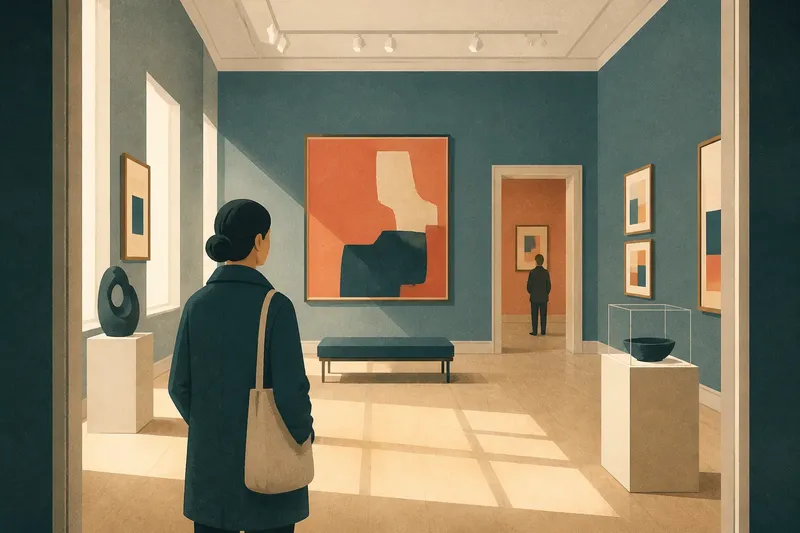
How can a short gallery visit feel complete without rushing through every room? A one-room gallery visit can give you a satisfying way in: choose a room, notice how it receives you, follow its sightlines and make space for a few deliberate pauses. You do not need to see everything. The point is to leave with a clear impression of how this room works and what stayed with you.
This plan is especially useful when you have a limited window, feel tired, or want to spend time with an exhibition rather than cover ground. Treat the room as a small landscape, with an entrance, routes, focal points and places where attention can settle.
1. Choose a room with a clear entrance
Pick a room you can enter without having to squeeze past a crowd or interrupt a guided group. A doorway that gives you a view inside is helpful, but a room that opens around a corner can be interesting too: you can register the difference between what you expected and what appears once you cross the threshold.
Before committing, check whether the room is open and whether the exhibition layout makes sense from its entrance. A gallery attendant can point out the room’s boundary if several displays share a space. If you are visiting with someone, agree on a simple limit: stay in this room for now, then decide whether you want more.
That small decision removes the pressure to make the visit comprehensive. It also gives your attention a useful edge: you are here to observe one contained arrangement, not to keep checking how much remains.
Choose the room that feels possible to enter and stay in, not the one that seems most important.
2. Pause just inside
Stop a little way past the entrance, somewhere that does not block anyone’s path. Let your eyes adjust to the room’s brightness and take in its overall arrangement before reading labels or moving towards a particular work. Notice the first thing your gaze lands on, then notice what you had to search for.
Look at the room’s proportions in ordinary terms: does it feel narrow, open, low-ceilinged or broken into smaller zones? Pay attention to changes in light, the colour of the walls and whether the floor or windows draw your eye. These features are not merely background. They affect how close you feel to an artwork and where you naturally want to stand.
Imagine you enter a room with a large painting visible straight ahead and smaller works along a side wall. If you pause just inside, you may notice that the painting commands the first glance while a window pulls your attention away. That first impression gives you something to compare with what you notice later; it does not have to be a judgement about which work matters most.
Stand where other visitors can still pass comfortably, and give yourself a quiet moment before choosing a direction.
3. Trace the sightlines
From the entrance, follow the routes your eyes can take without moving your feet. A doorway may frame one artwork. A long wall may lead towards a sculpture at the far end. A gap between displays might open a view into another part of the gallery, even if your visit remains centred on this room.
Then move to a second position, perhaps near the room’s centre or at one side, and look again. Does an artwork appear differently when it is no longer framed by the entrance? Can you see a relationship between two pieces from here that was hidden before? In a room with a screen, plinth or partition, notice what it conceals as well as what it reveals.
Walk only as far as you need to test those views. You are not trying to draw a perfect map. The useful question is how the room directs attention: towards one focal work, along a sequence, or between several competing points.
Changing your position can make a familiar-looking display feel newly arranged.
4. Follow the room’s route
Notice whether the layout suggests a direction. Works may be arranged in a sequence around the walls, grouped into clusters, or placed so that you can approach from several sides. If there is no obvious route, start with the wall that is easiest to reach and move at a pace that leaves room for other visitors.
Pay attention to transitions. A tight passage may open into a broad stretch of wall; a group of small works may give way to a single large object. Such changes can create rhythm without any written instruction. You can follow that rhythm, or pause where the sequence seems to ask for a closer look.
Keep the route flexible. If someone is already viewing a work, give them space and return to it later. If a display is roped off or has a marked viewing area, respect that boundary and use the accessible vantage point rather than trying to get closer.
Let the room’s arrangement suggest a path, but do not mistake it for an obligation to move in only one direction.
5. Make one deliberate pause
Choose one place to stay for a little longer: a bench, an open patch of floor or a spot from which you can see several works without standing in anyone’s way. A pause is not a test of concentration. It is simply a chance to notice what changes when you stop moving.
You might see a reflection shift across glass, hear how sound carries from the doorway, or notice that an artwork feels less isolated when viewed beside another. If the room has no seat, rest briefly at a point where you can stand comfortably and safely. Avoid leaning on walls, plinths or display cases.
Use the pause to return to one question from your first impression. Did the focal point stay central to you? Did a quieter corner become more interesting? What can you see now that the entrance did not reveal?
A single unhurried pause often gives the visit its clearest centre.
6. Let the exit change the view
Before leaving, turn back towards the room from near its doorway. The view out can feel different from the view in: you may see the route you took, the work that held your attention or a detail that was easy to miss at first. This brief look helps you register the room as a whole rather than departing as soon as you have seen the last display.
Notice whether your eye returns to the same place as before. If it does, ask what made that view persistent: its position, scale, colour, lighting or relation to the entrance. If your attention has moved elsewhere, that change is part of the visit too.
Then step out without trying to turn the room into a complete verdict on the exhibition. You have made one considered visit, not a claim to have seen everything the show offers.
Take one last look from the threshold before moving on.
7. Keep a small record
If you want to remember the room, make a brief note after you leave it. Write down the first view, the spot where you paused and one feature of the layout that shaped your attention. A few words are enough; you do not need to catalogue every artwork or recall every label.
For example, you might note that the entrance framed a bright canvas, that the benches faced away from the window, or that a narrow route opened into a quieter corner. These observations are more useful than a vague entry such as “nice gallery”, because they preserve the experience of being in that particular space.
Follow the gallery’s rules about photography and note-taking. If photography is not permitted, a written description can capture the room without disturbing other visitors.
Keep the record focused on what the room made visible, not on how much you managed to see.
Questions about one-room visits?
How long should I spend in one gallery room?
Stay for as long as you can remain attentive and comfortable; there is no required duration. A short visit can still have shape if you pause at the entrance, follow a sightline and take one deliberate look back.
Should I read every artwork label?
Not if your aim is to notice the room’s arrangement. Read a label when it answers a question you already have, then return your attention to the artwork and the space around it.
What if the room is crowded?
Choose an unobstructed edge, wait for a clear view or return when the space eases. Do not block a doorway or press close to a work just to complete the route you had in mind.
Can I visit one room when the exhibition spans several?
Yes. A one-room visit is a focused way to spend time, not a substitute for seeing the full exhibition when you have the opportunity. If another room catches your interest, you can choose to continue after you have finished with this one.
A gallery visit built around one room works because it gives attention a manageable place to land. The entrance, changing sightlines and pauses offer enough to notice without turning a visit into a race. When you leave, carry one specific observation with you: perhaps a doorway’s frame, a surprising view across the room or the corner that only became visible once you stopped.