From Empty Wall to Shared Landmark: Public Art and Place
Public art and place gain meaning through repeated encounters. Learn how to notice the work itself, the stories around its setting and what changes over time.
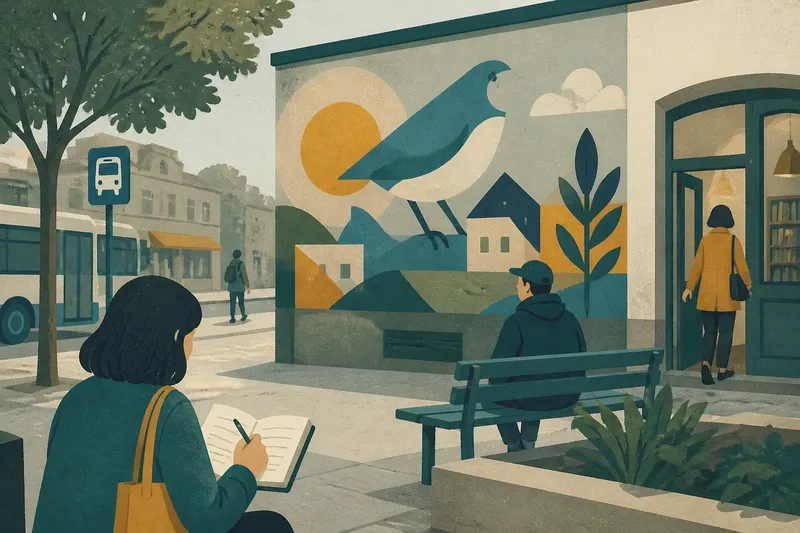
What makes an empty wall feel like a shared landmark rather than a painted surface? Public art and place become connected through ordinary encounters: the route to the bus stop, a pause outside the library, a conversation beside a painted shutter. The artwork matters, but so does the place where people keep meeting it—and the difference between what the work shows and what its setting comes to mean.
You can follow that change over a week without trying to decide what the artwork “really means”. Visit at different moments, notice what remains visible, and listen for how people talk about the location. Treat the work as one thing and the stories gathered around its setting as another. That distinction makes room for several perspectives without turning local memory into an official explanation.
A week of encounters
Choose one public artwork you can visit safely as part of an ordinary route. It might be a mural beside a corner shop, a sculpture near a playground, or a mosaic outside a community building. Pick somewhere you can see from a public place without crossing barriers or interrupting people. The plan is not a formal survey; it is a way to notice how the work shares space with daily life.
Keep a small notebook or use a note on your phone. Record the date, approximate time, weather, where you stood, and what drew your eye. Describe visible details before interpreting them: a red shape, a repaired crack, a tree shadow across the surface, or a doorway that frames the work. Those observations give you a clear starting point later.
- On the first visit: note what the work physically contains and how it sits in its surroundings.
- On the second: approach from another public direction and notice what comes into view first.
- On the third: watch how people use the surrounding space, without recording identifying details or intruding on private conversations.
- On the fourth: look for changes caused by light, weather, temporary signs, planting, or nearby activity.
- On the final visit: compare your notes and separate what you observed from what you heard or inferred.
Visits need not be long. A glance during a familiar walk can be enough, provided you record what changed in your own attention. If the location is closed, crowded, or uncomfortable, choose another time or observe from a suitable public viewpoint.
Keep the same basic questions across the week. What can you see? What is happening around it? What do people appear to do with the space? What are you assuming? That last question is useful: a well-worn path may suggest a regular route, but it does not tell you why someone chose it.
Work and setting
The artwork itself includes its visible form and material: a painted wall, a carved figure, a pattern in paving, or an object placed in a square. Its size, colour, texture, position, and relationship to nearby surfaces are things you can describe directly. If you know the artist or title from a reliable sign, you can record that information, but it does not replace looking at what is there.
The setting includes the building, street, landscape, and practical uses around the work. A wall may belong to a shop, a school, a housing block, or a public underpass. The space may be a shortcut, a meeting point, a place to wait, or simply part of the view from someone’s kitchen window. These conditions affect how the work is encountered, even when they are not depicted in it.
Stories attached to a setting are different again. Residents may connect a mural to a former market, a local celebration, or a difficult change in the neighbourhood. Someone else may know it mainly as a landmark on the walk home. Such accounts can be meaningful without all describing the same thing. A story about the place does not automatically establish the artist’s intention, and the artwork alone cannot confirm every detail of local history.
Try writing three short notes under separate labels: What I see, What this place is used for, and What someone told me. Mark guesses as guesses. That small separation helps prevent an appealing local story from being mistaken for something visibly present in the work.
Changes in attention
Repeated encounters often reveal practical changes rather than dramatic transformations. On a bright morning, glare may flatten a painted surface; later, a low sun may bring out its texture. A delivery van might temporarily hide part of a wall, while a queue outside a café alters how closely people can approach it. Rain can make colours appear deeper, or leave the surrounding pavement too slippery for a comfortable pause.
People’s routines also shape what becomes noticeable. A person hurrying to work may register only the work’s outline. A child waiting for a friend might point out a small painted animal that an adult has overlooked. Someone using a walking aid may experience the path, curb, or seating as more immediate than the artwork. These are not competing readings of a single image so much as different encounters with a shared setting.
Imagine you pass a tiled panel outside a neighbourhood library on your way to collect a book. On Monday, you notice a blue bird in the design. On Wednesday, a neighbour tells you that the spot used to be where people waited for a community bus. By Friday, you see someone sitting on a nearby bench and using the panel as a meeting point. The bird remains part of the artwork; the former waiting place is a story about the setting; the meeting is an observed use. Keeping those details distinct lets each add meaning without one claiming to explain the others.
Write down absences as well as activity. If nobody is nearby, that is a description of one visit, not proof that the work is ignored. If people gather around it once, that does not establish a permanent custom. Careful wording keeps a modest observation useful.
Listening with care
Local accounts can deepen your understanding, but you do not need to collect them. If someone volunteers a story, listen without pressing for personal details. Ask a simple, open question only if the moment feels appropriate, such as what they remember about the place. Let them decline, and do not record a name or share an identifiable account without clear permission.
For background, look for information the artist, commissioning organisation, local council, or community group has chosen to make public. A sign or public project page may explain who commissioned the work and what its stated aims were. Treat that material as one source about the work, not as a replacement for residents’ memories or your own observations.
When accounts differ, record the difference rather than smoothing it away. One person may describe a wall as newly welcoming; another may associate it with a business that has since closed. Both statements can tell you about how the setting is remembered. Neither should be presented as the sole voice of a whole neighbourhood.
If you later write or speak about the artwork, distinguish direct observation, attributed accounts, and interpretation. For example, “A resident described the corner as a former gathering place” identifies whose account it is. “The artwork restores the corner’s original meaning” makes a much stronger claim and may not be supported by what you know.
Questions about public art?
Does a landmark have to be famous?
No. A landmark can be a familiar point of reference for people who live, work, study, or travel nearby. Its importance may be local and practical, built through recognition rather than broad attention.
Can the location change an artwork’s meaning?
Yes, the setting can affect what people notice and associate with the work. That does not mean every story attached to the location was intended by the artist or is visible in the artwork itself.
How can I tell local memory from artist intention?
Start with the source: a public statement from the artist or commissioning body is different from a resident’s recollection or your own interpretation. Keep the accounts clearly attributed, and avoid treating one as proof of the other.
What if I cannot find reliable background?
You can still describe what is visible and how the place is used during your visits. Leave uncertain history open rather than filling the gap with a confident-sounding guess.
A small record
At the end of the week, make a simple record rather than a verdict. Include the work’s visible features, the route or public space around it, changes you noticed, and any local accounts you have permission to repeat. Add where and when you observed each detail. If you share a photograph, consider whether people, homes, or private activities are identifiable in the frame.
You might end with two sentences: one about the artwork and one about the setting. “The panel shows a blue bird among tiled leaves. Outside the library, the corner is also a place where neighbours stop to talk.” The sentences can sit beside each other without claiming that the bird represents the conversation or that the conversation explains the panel.
Public art and place acquire meaning through recurrence, but repetition does not make every interpretation equally certain. A careful observer can hold the material work, the changing setting, and the stories people attach to it in view at once. On your next familiar walk, note one detail you can see and one part of the place that is doing something else around it.